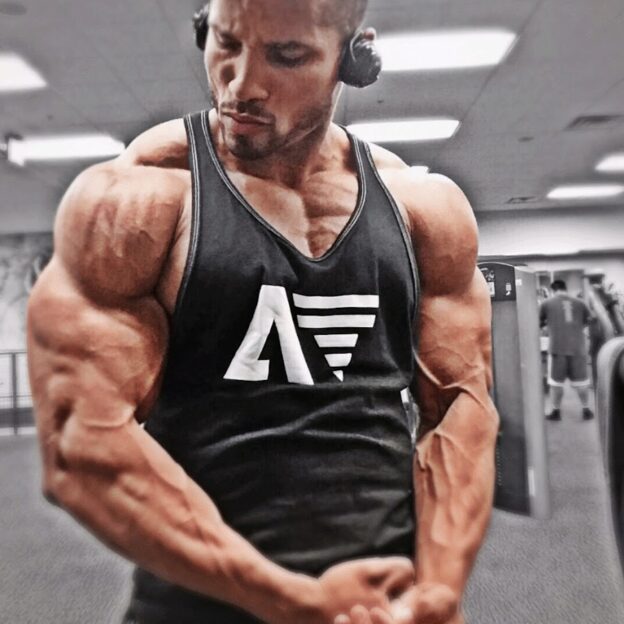
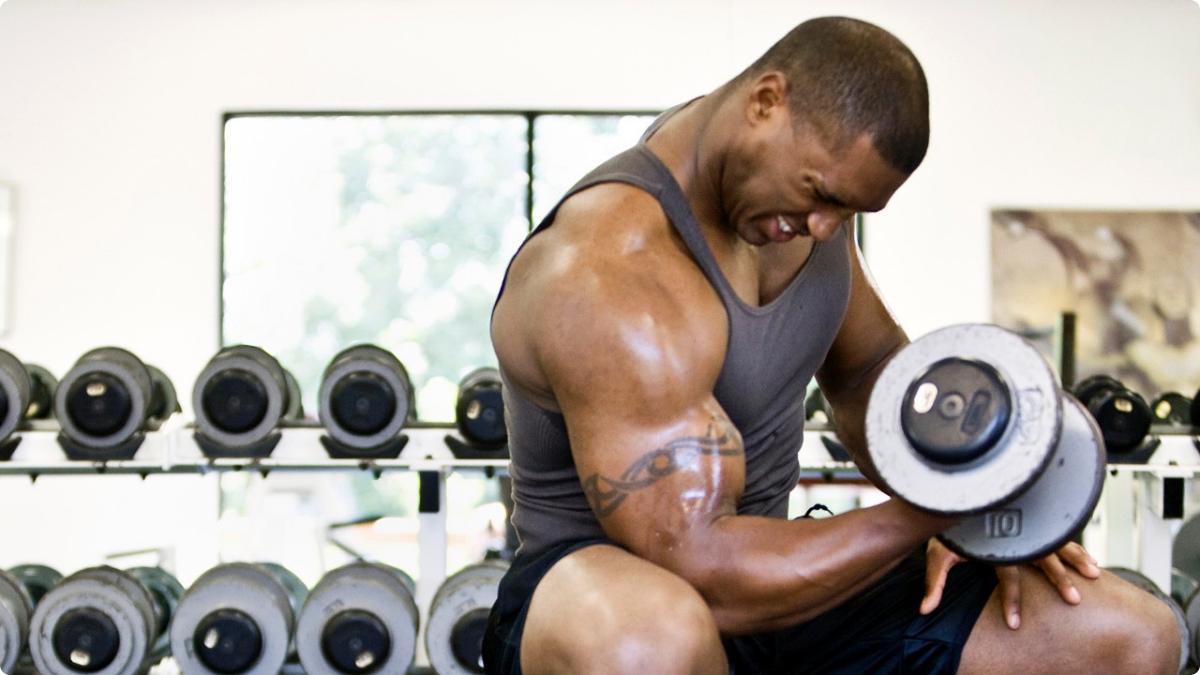
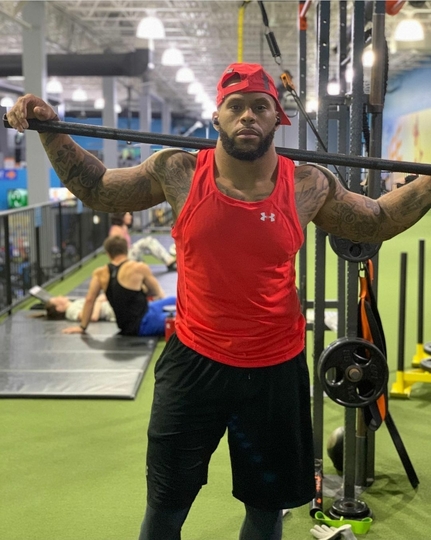
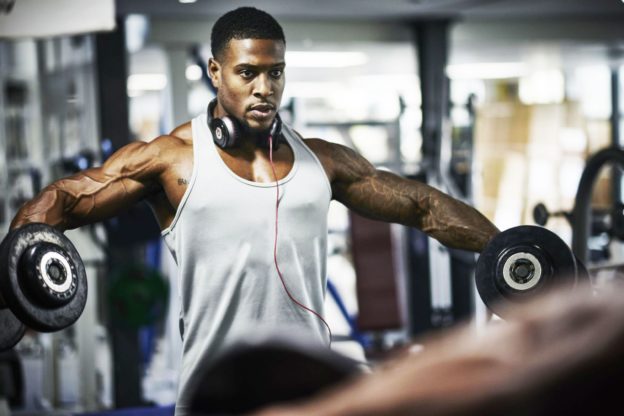
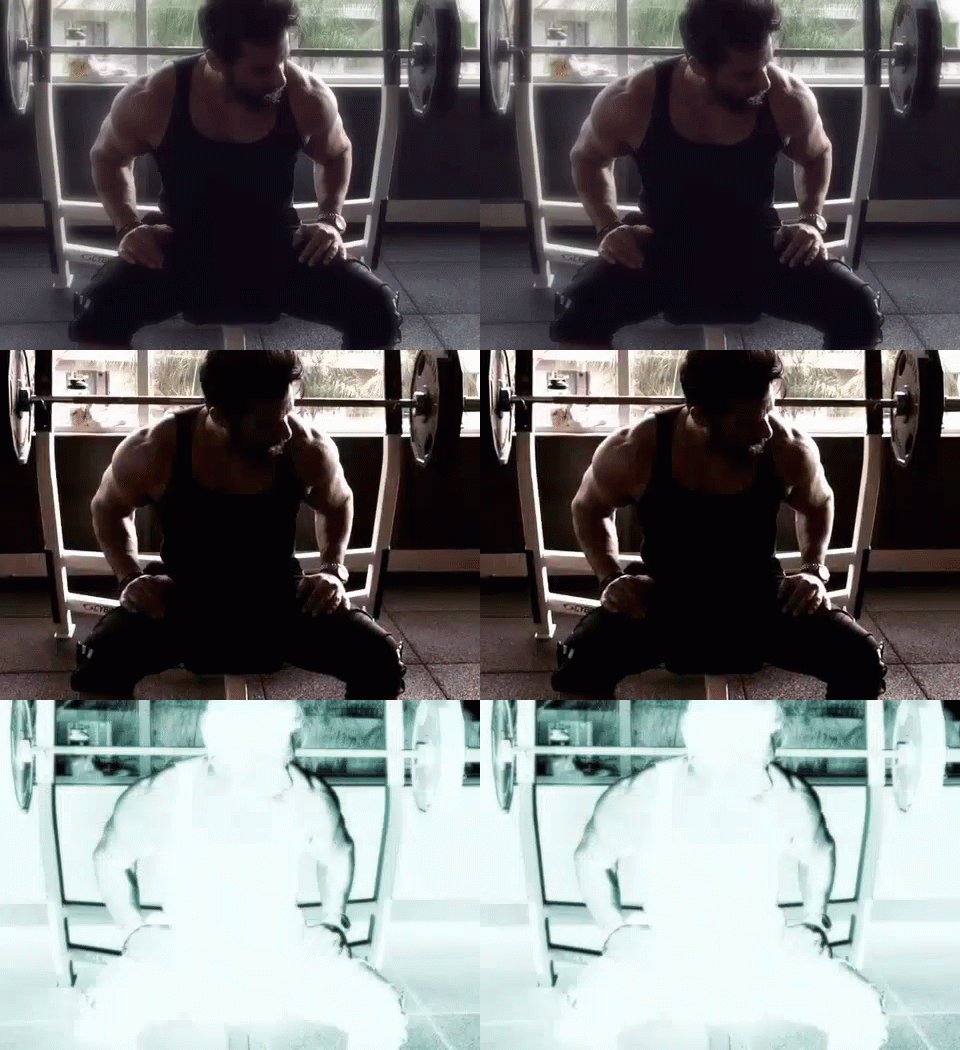
IFBB Pro, Damien Patrick shares a shoulder workout full of dropsets and supersets. I tried this today and I guarantee it will give you a “STUUUPID Pump”! Give it a try…..
If you want to get more programs like this that have been designed by Damien, head to www.damienpatrick.com . You can also download his app for all of the program info and content!
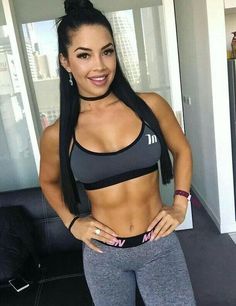
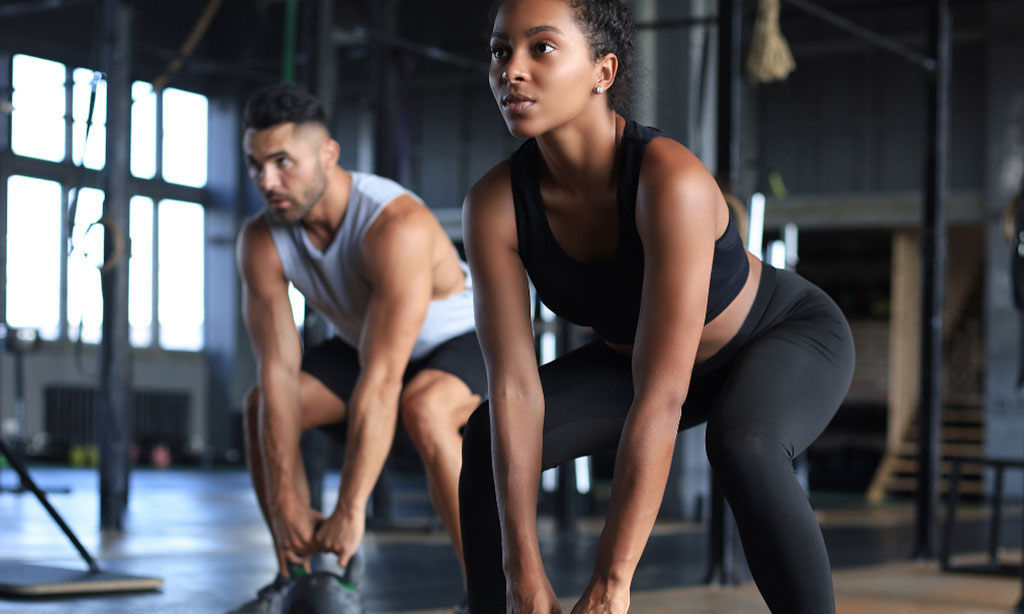
3x WBFF Bikini World Champion and Pro trainer, Rachel Dillon shares shares a quad focused session for the ladies. This should be a quick 30 minute session using a superset and a giant set to scorch the quads! A short focused intense session. Good luck!!
Part 1 – Superset – Barbell Sissy Squats, Incline Dumbbell Squats – 60-90 seconds reset after each round
Barbell Sissy squats 4×15
1) Place your heels should on a slightly raised surface, like a weight plate.
2) Keep your feet shoulder-width apart, toes pointing forwards, shoulders back and down, and pull the bar down to lock in your upper body .
3) Bend at the knees and lean the body backwards, so that the tension comes into the front of your thighs.
4) Lower back as far as you can, keeping a neutral spine throughout. You should form a straight line from your knees to your head.
5) Pause at the bottom before slowly pushing back up to the starting position.
Dumbbell Incline Squats 4×20
1) Place your heels should on a slightly raised surface, or a slant board .
2 Lift the dumbbells up to rest on your shoulders to keep your upper body tight and in upright position. Brace your core .
3) Bend at the knees and lean the body backwards, so that the tension comes into the front of your thighs.
4) Lower back as far as you can, keeping a neutral spine throughout. You should form a straight line from your knees to your head.
5) Pause at the bottom before slowly pushing back up to the starting position.
Part 2 – Giant set – Barbell Walking Lunges, Step-ups, Bulgarian Hops – 60-90 seconds reset after each round
Barbell Walking Lunges 3×20
Begin standing with your feet shoulder width apart and a barbell across your upper back.
Step forward with one leg, flexing the knees to drop your hips. Descend until your rear knee nearly touches the ground. Your posture should remain upright, and your front knee should stay above the front foot.
Drive through the heel of your lead foot and extend both knees to raise yourself back up.
Step forward with your rear foot, repeating the lunge on the opposite leg.
Plate Step-ups 3×15
Hold a plate in front of you at shoulder level and place one foot on a bench or box, your knee bent to 90°. Keeping the other leg straight and firmly planted on the ground, push your shoulders back and chest out.
Push through your top foot to raise your body over the platform, your back leg suspended in the air.
Bulgarian Hops 3×20
Standing in front of a bench (or chair, etc.), facing the opposite direction, place your rear foot on top of the bench – shoe laces down.
Make sure you place your front foot far enough forward so you are in a full lunge position, not too close to the bench (see illustration), and be sure your weight is your front heel.
Maintaining your balance, slowly lower your body down until your back knee almost touches the ground (the depth will depend on your mobility and stability and the height of the bench). Be sure to keep your upper body straight and upright and don’t let your knee come past your toe or shift inward or outward.
Stand back up in a controlled manner until you’re in the upright position again (without locking the knee). Maintain proper alignment. Hands can be at your side, out in front of you or above your head. They can also be out to the side if you find it easier to balance this way.
Save this post and give this session a try. Let us know what you think. Train Hard Ladies!!
If you would like to try more of this style of workout. Rachel’s Busy Girl programs can be found at www. movewithus.com
Recently, I have been having a lot of conversations about nutrition and losing weight (fat loss). I have come to realize that there are not many people that take the time to understand the nutrition side of health and fitness.
(I have also realized most people do not know the difference between weight loss and fat loss. They use the terms interchangeably. Just because you lose some weight on the scale, does not mean it was a positive change…. food for thought)
For sake of time, let’s make one thing clear! You by no means have to eat like a physique competitor to lose weight, lose bodyfat, improve your body composition, or however you describe your physical goals. But the ultimate goal should be the same as a physique competitor (although less extreme)… to become lighter, leaner, and in better physical condition.
Yes, restricting yourself to a specific group of foods that you weigh and monitor calorie intake on a daily basis is going to get you there. But, that is just not a realistic approach for the majority of today’s society.
Now on the other side of that coin, you cannot continue to go down the path that you are currently on as you are just not seeing the results you hoped for. Which I am sure is pretty demotivating.
So with that being said, if you are looking for some simple ways to streamline your existing nutritional approach for hitting that target weight (fat) loss goal, try to incorporate these few strategies below!
Think Slow And Sustainable
For all of the trainers/coaches out there I have to say this.
Losing “10 lbs in a week” or “30 lbs by my birthday (5 weeks away) are just not realistic goals!!!
Very few individuals achieve those types of results….. very few!
In order to make those type of changes you have to be 100% on top of everything you eat, the cardio you do, the workouts, and there are no breaks!! No going out with friends. No grabbing a meal because you have been good all week. No drinking. None of that!!
And even with that level of discipline, there is no guarantee you will meet your goal in the allotted amount of time. The other side of that is even if you do meet the goal, you are almost guaranteed to go right back to where you started…. Or worse!
Set realistic goals for yourself. Create habits that can be sustained for long periods of time. Slow and steady always wins the race with this fitness lifestyle.
You do not need to commit to a super-restrictive 90-day or 12-week challenge in order to lose weight. In fact, for many people, thinking in shorter time frames, such as 4-6 weeks will actually work better.
Any experienced nutrition coach or certified nutritionist would recommend that you lose weight at a pace no faster than .5-1 percent of your body weight per week (1-2 lbs of body per week). Over six weeks for a 150-pound person, that’s 7-8 pounds.
That may not sound like a lot, but it’s enough of a sample size to assess the your eating habits to determine which changes you made worked and which didn’t work. With this information, you’re better equipped to weed out those changes that are not sustainable for you, and to focus on those that are. Then, you can implement those positive changes in your plan of action over the next 4-6 weeks.
Ultimately, this will help shape a foundation of sustainable, healthy eating habits that will serve you for a lifetime rather than feeling the need to commit to 90 days of misery only to revert back to your previous ways (and weight!) when a “challenge” is done.
Figure Out A Meal Frequency That Works For You And Stick To It
I get this question a lot!! How many meals per day do I need to eat? Through my own trial and error and experience, i have learned the answer is simple: Whatever aligns best with your lifestyle!
Seriously! When the calories and the protein intake are about the same, there’s no added weight-loss benefit if you choose to a warriors diet of once a day or if you choose to eat three to six times per day. Choose a frequency that fits into your lifestyle and is sustainable in the long run. That’s what matters most.
I think its worth stating that many active people find it best to eat every 3-4 hours because this helps to maintain steady energy levels throughout the day while also keeping hunger and cravings in check. This usually shapes up to three main meals and 1-2 snacks per day.
The same goes for meal timing. If you want to consume the majority of your daily intake at breakfast, or the majority in the evenings, go for it. What matters most is that your total daily intake remains more or less consistent day after day. However, as you grow on your journey and seek further progress, having some structure of meal timing may benefit you because it will allow you to optimize performance when working out, as well as recovery. You also have better control of your appetite and cravings throughout the day.
Take Aim At Your “Problem Meal”
Full-on meal prep isn’t an option for many people.
And that’s OK!
But it’s also true that many of us have a single “problem meal” during the day where we buy something rather than make it.
For example, maybe lunch is your weakness, and you find yourself at the food truck several times a week. Maybe breakfast is a sugar-bomb and has been since you were a kid. Or maybe your meals are OK, but your snacks are a complete disaster!
No matter the case, taking the initiative to prepare your most problematic meal or snack—and just that meal or snack—can have a profound difference. And “fixing” just the most problematic meal is far easier than trying to prep all your meals, all the time—although that is definitely an option as well (and highly recommended), if you’re up for it.
Look For Easy Low-Calorie Substitutions
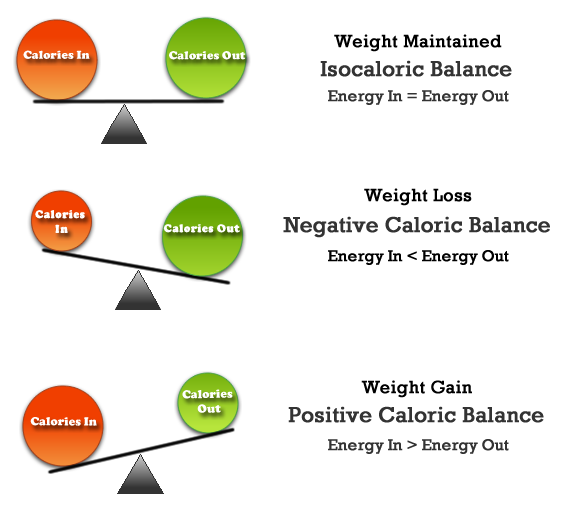
When you begin seeking weight loss, there’s one key relationship that you need to be aware AT ALL TIMES the relationship between the number of calories you eat per day and the number of calories you burn per day. If you eat fewer calories than you burn, over time you’ll lose weight. Conversely, if you eat more calories than you burn, over time you’ll probably gain weight.
A lot of people will take that starting point and tell you that you need to count calories. It’s not true! Instead, you can look for ways to make a single change or two to your day to begin taking in fewer calories.
This could mean:
Swapping soda for diet soda or soda water (or WATER!!)
Swapping juice or a sports drink for a low- or no-calorie alternative
Swapping a bag of chips for a piece of fruit or cheese
Swapping a candy bar for a handful of nuts and seeds
Along with a consistent workout schedule, consuming just a couple hundred fewer calories per day, when done consistently, can jump-start weight loss.
That said… you can’t have a diet soda once per week, drink regular soda for the rest of the week, and expect to make groundbreaking weight-loss progress. You need to implement your chosen strategies consistently so that your body has adequate time to react to the impact of you eating fewer calories per day.
Keep A Craving-Fighting Strategy Or Two In Your Back Pocket
The easiest hunger-fighting strategy you can implement right now is to drink more (calorie-free) fluid.
When you drink fluid, it rapidly fills your stomach. When you drink a significant quantity at once, such as 8-12 ounces, it fills your tiny stomach almost completely. When this happens, the fluid forces your stomach wall to expand, which triggers a signal to be sent to the brain basically saying there’s no more room left in the stomach.
The next-level strategies? Start prepping at least some of your meals (more on that soon), or at minimum, your snacks. Dial in your snack game, looking for simple meals and recipes that combine protein and nutrient-dense foods like nuts and vegetables. If you are unable to keep meals with you, below are some quick options you can pick up when you are out and about.
Have these ready so you don’t find yourself ravenous when passing the drive-thru window!
If losing weight (bodyfat) is your goal; try these simple strategies out. The honest truth is, subtle changes in your eating habits will yield big results when you start the process…
BUT
Do not forget to always monitor your calorie intake vs your caloric output! And keep making small changes so that you are able to maintain those habits as a life long practice!
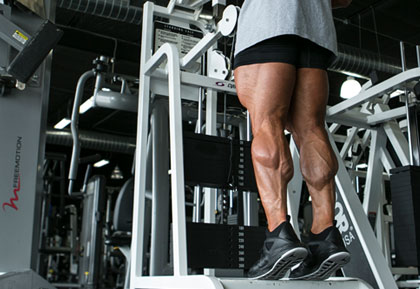
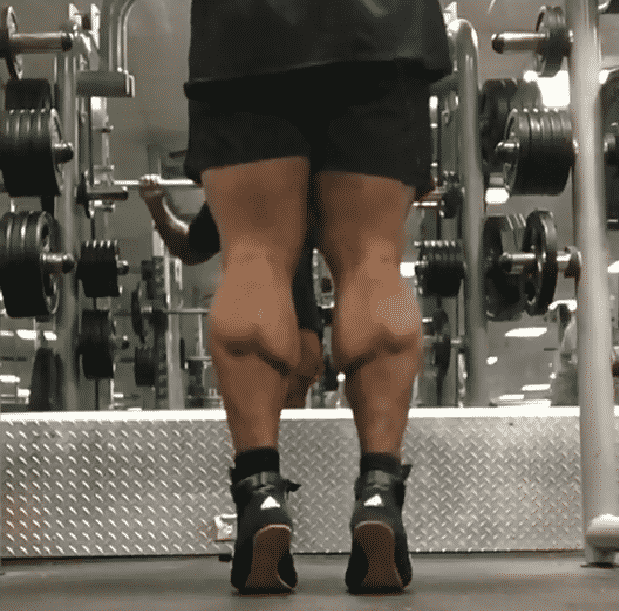
An awesome set of thick, diamond-shaped calves is one of those “little” things that really sets a great physique apart from a mediocre one.
Small, under-developed calves, on the other hand, become a glaring weak point as your upper body develops and greatly diminishes the look of your overall physique. You could be squatting 500 pounds but if your calves aren’t up to snuff, it’ll look like you’ve got chicken legs. (And trust me, I know–I neglected my calves for years; and it took me years to catch up). So basically what I am trying to say is..
NEVER NEGLECT YOUR DAMN CALVES!!!!!!!!
The calf routine that i am sharing was published in Iron Man Magazine in 1971 by Jim Mclellan. Now Mclellan was a known golf instructor, but back in the day was an Old School bodybuilder that was also known for specifically for the calf training routine he developed.
Legend has it he added 1.5 inches to his calves in just 8 weeks.
Legend or not, if there is the possibility of that type of growth; I don’t know about you, but I am going to try it!!!
His program is designed to grow stubborn calves, as well as punk those individuals who have great calves and neglect to work them. I must warn you!! It doesn’t matter if you are a beginner or a veteran gym junkie; you WILL feel the effects of this routine immediately. So please take the proper precautions to survive the gauntlet. Hydrate, stretch, massage your calves, and pray that you can stand up the next morning.
The Jim Mclellan Crippling Calf Program
Find a place where you can do standing calf raises with additional resistance. If you’ve got a standing calf machine at the gym, perfect. No calf machines in sight? Two options: Get inside the smith machine , put the bar on your back and stand on a 4-inch block. Or, you get a hip belt, chain up some plates or a dumbbell and stand on a step.
Start with 15 full ROM reps. Full ROM means at the bottom of each rep, dip your heels as low as you can so that your calves really get a great stretch. And at the top of each rep, raise your heels as high as you can so your calves are forced to contract fully.
Keep these reps slow and smooth.
After the 1st set of 15 – Rest 10 seconds
Now, do 10 more calf raises. Again, slow and smooth. Then, rest 10 seconds. Then, 10 more calf raises. Repeat this two more times for a combined total of 55 reps. By this point, your calves will be on fire… but the fun is just beginning.
After the final rep, you’re going to stay on the block and immediately start doing “burns.” These are short, fast, bouncy calf raises. Don’t worry about dropping your heel as low as you can or rising up as high as you can on your toes. Just focus on speed – knocking out as many mid-range calf raises as you can. You should be trying to actually explode off the block — in reality your toes won’t leave the block but you should be trying to do these fast enough so that it feels like you’re about to lift off the block. Then you come crashing down and your calves are forced to stop the momentum.
This will LOOK like you’re cheating — but what you’re really trying to do is torture the calves and do the burns for as long as you can. Don’t bother trying to count reps — you will be moving too fast for that. Just fight through the pain for as long as possible.
When you can’t take another second, now it’s time for negatives.
Stay on the block, and do a full calf raise with both feet, but then remove one foot from the block and lower yourself slowly using only leg. Lower yourself all the way to the bottom, then lift yourself up again with both calves. And at the top, remove the opposite leg and again lower the weight slowly using only one leg.
Do 10-12 negatives for each leg. When you’re finished with these, take a 3-5 minute rest. Massage your calves, walk around a bit and give each calf a good stretch. It will be painful, but do it anyway. After the 3-5 minute rest period is over, do the entire routine again.
Complete this same routine 3 times throughout the week.
After two weeks on the above routine, you’ll make the following change: After the negatives, add another round of “burns” and then another round of negatives. Making this change will help increase time under tension and keep the progress going.
Ok, so that’s the basic routine. Here are a few additional notes to focus your calf training…
Train calves 2-3 times per week. The calves are brutally tough and they need to be punished over and over, many times in the same week to make them grow.
Train calves first in your workout.
Use the same amount of weight for the entire calf training session.
You don’t need to use heavy weights for this routine to work.
The key is to punish your calves. It’s all about how long you can deal with the pain. Do NOT be nice to your calves.
Don’t stop when you can’t get a full rep. That’s not failure. Keep going until you can’t raise up your heel even a single inch. When your calves are so fried that you can’t make your heel raise up even a single inch, that’s failure.
Most people with great calves go them from their parents – not from hard work.
If you were born with terrible calves, you’ll probably never have great calves. But you can improve on what you’ve got by working hard to train them.
Again, this is NOT for the faint of heart. You may not enjoy the pain and soreness, but you’ll love the results. The saying goes:
If you want something you have never had… you have to be willing to do something you have never done!
Let me know how this routine works out for you… leave me a comment. Train hard!!!!!!!
A lot of the nutrient deficiencies shared in this video not only have a direct impact to your health (as you will see the specific effects related to missing nutrients), but also expresses the importance of maintaining sound and consistent nutrition habits. Both have an direct impact on your time spent in the gym and if there is one thing I know about gym junkiez; you do not want anything impacting your performance or progress in the gym or with your physique. Hope this video helps.
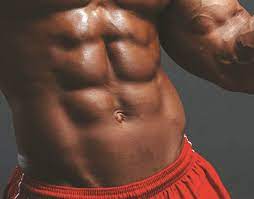
A set of washboard abs is one of the most visible benchmarks for male physiques – a true sign of dedication and one that you see plastered on billboards and fashion posters across the globe. For women, a toned stomach with visible abs is a great indicator of your fitness and strength.
However, for most people, getting your abs to show can be a tricky challenge. There are a number of factors involved in training your stomach. If you want a rock-hard set of abs that can be spotted on the beach, you’ll need to be aware of the 10 reasons you can’t see your abs.
1. You Have Too Much Body Fat.
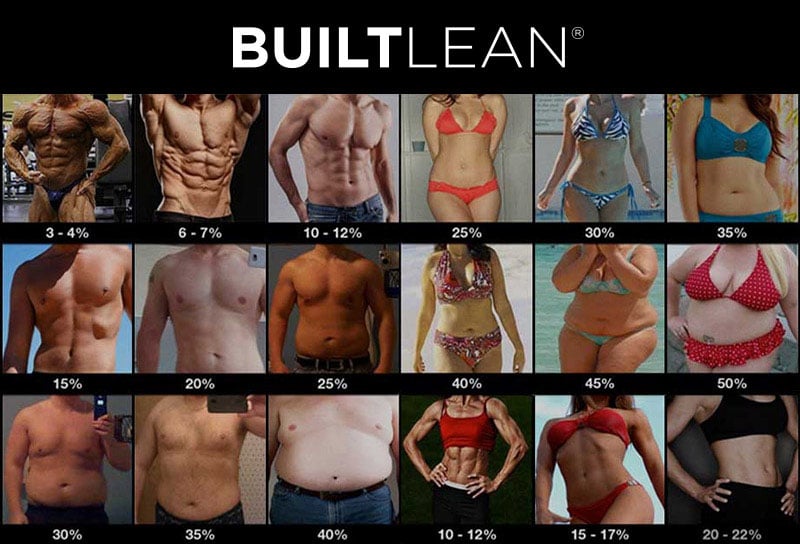
The single most important aspect when it comes to getting your abs to show is having a low body fat percentage. All humans have abdominal muscles that can be made more visible with training – but ultimately to see your abs you need to be at 10% body fat or less (18% or less for women.)
Ditch the fad diets and stop performing endless crunches. If you’ve got too much body fat you’re not getting anywhere.
2. You Focus On Sit-Ups And Crunches.
Performing endless amounts of bodyweight crunches and sit ups will not build up much in the way of ab muscle and certainly won’t help drastically reduce body fat. While bodyweight exercises will help boost your metabolism and burn calories – there are many more effective exercises you can do instead. But in the end you only have two choices. Lose body fat through diet.. or through diet and cardio.. one takes longer than the other, but those are two options!
3. You’re Forgetting How To Actually Build Muscle.
One of the best ways to build muscle is to perform heavier sets with fewer reps. This means adding resistance to any ab exercises you’re doing. Experiment with cable crunches and doing sit-ups whilst holding a weight plate. Performing lower reps such as 10-12 for 3 sets with a weight can yield better muscular growth than doing 100 unweighted crunches at a time.
4. You’re Overtraining The Ab Area.
Excluding fitness professionals whose bodies are used to their constant daily routine of training their abs at the end of sessions, the average gym goer should understand that rest is just as important as training. Like your arms or legs, your abs need time to recover and grow.
5. Your Nutrition Plan Is Not Effective.
If any of the 10 reasons you can’t see your abs was to be key – this might be it. The importance of losing body fat has already been presented – but to actually lose the weight you’ll need to be eating in a caloric deficit.
Fad diet tactics to rapidly reduce weight such as liquid diets might get you a visible set of abs for a single day, but then you’ll pile weight back on.
Instead, your nutrition should be tailored around a reduction of calories whilst continuing to eat healthy food. Cut down on refined carbohydrates and sugary treats. One of the truest fitness anecdotes you’ll ever hear is that ‘Abs are made in the kitchen.’
6. You May Have Non-Ideal Genetics.
Sometimes it’s not about how to get your abs to grow. Sometimes, It’s a case of having poor ab genetics. Some people are more genetically inclined to lose weight quickly in the stomach area and have more pronounced, well-built abs at greater levels of body fat. There are people who can still have visible abs at 15% body fat, where others may need to hit a little as 6%.
Do the best you can to reduce your body fat and don’t compare yourself to others – they may have an unfair advantage. Your hard work will pay off.
7. You May Be Too Stressed Or Too Tired.
When stressed, your body releases cortisol. An excess amount hinders fat loss. Cortisol is catabolic, which means it can break down tissue. If you’re trying to get abs, you’ll want to put your body in an anabolic state – so avoiding stress is vital.
Sleep puts cortisol levels at their lowest during your slow wave sleep stage. Prioritizing a good night’s rest will help put your body in the best state it can be to lose weight and build muscle.
8. You Might Be Drinking Too Much Alcohol.
Are you often heading out with the intention of having a few beers on the weekend but often ending up with a full weekend of excess drinking? Your body will not be grateful. Just as you need to lose body fat, you also need to cut down on alcohol.
Whether you’re downing pints or sticking to slimline drinks, alcohol is still a catastrophic hindrance in getting your abs to show. The excess calories aside, alcohol reduces testosterone, messes up your sleep pattern, shuts down fat burning and strains the liver. If you want to look ‘cut’, you’ll need to cut the alcohol.
9. You Have Unrealistic Time Expectations.
Getting ripped isn’t the quick process you might think it is. Losing body fat is a hard thing that requires time and dedication. Your body does not want to make a quick change – and due to the low amount of bodyfat you need to have visible abs, you might feel like they’re never going to show and give up.
As long as you eat at a caloric deficit, put healthy foods in your body and perform the right kinds of exercise, you’ll see results. Just don’t expect to see them instantly.
10. You’re Not Sticking To A Routine.
With every single fitness goal – whether it’s to build lots of mass, gain strength, slim down, compete in an event, or getting your abs to show, dedication is the single most important thing. You need to give a routine time to work. Don’t just switch from one gimmick to the next and expect to see a six pack.
Hard work, effort and a well-structured routine will get your abs to show. You’ll need a strict caloric deficit combined with cardio exercise to help lose fat and some mass-building stomach exercises to really get your abs to ‘pop.’ Stick to the routine, give it time and you’ll see the results of your hard work.
These are just a few reasons why your abs are visible as you want them to be… . Do you have others? Please share them in the comments and let’s discuss.
This is the perfect subject for this ending. Eat Smart! Train Hard!
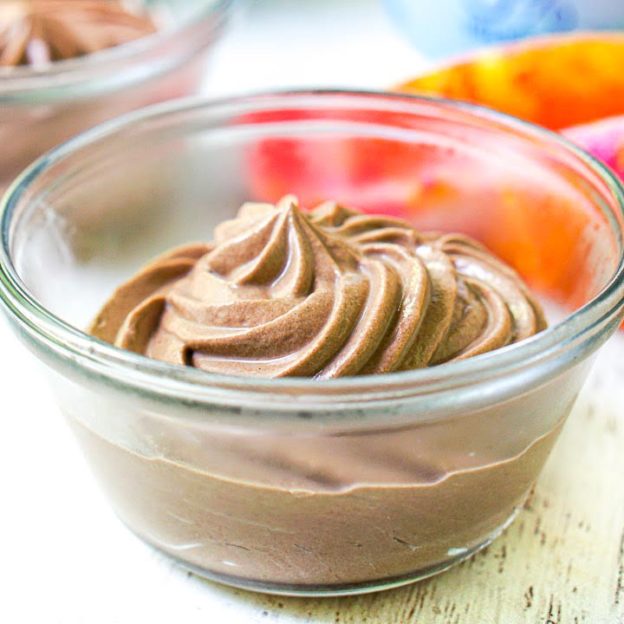
This low carb chocolate soft serve ice cream only needs 3 ingredients and 5 minutes to make a creamy, sugar free keto friendly dessert.
INGREDIENTS
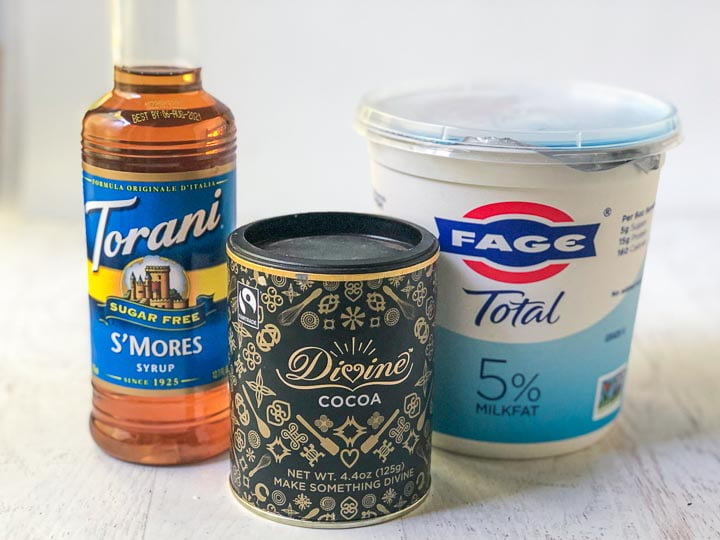
1 cup Fage Greek Yogurt (5%)
2 tablespoons Divine Cocoa powder
3 tablespoons Torani sugar free S’mores syrup
Optional – MTS Whey Protein (see notes for recommendations)
INSTRUCTIONS
Mix all ingredients together well. Then spoon into two small bowls.
I used an icing bag to make it look like soft serve but you can just spoon it into the bowls.
Eat right away or store in the refrigerator.
If you want it colder, you can freeze for 30 minutes but make sure to mix halfway through.
See recipe notes for more ways to change up this recipe.
NOTES
The nutritional information for 1 serving is:
169 cals / 8.5g fat / 9.5g carbs / 5.5g fiber / 13g protein = 4g net carbs
****** with protein powder 38g of protein *******
RECIPE TIPS & NOTES
Its best to use 5% Fage Yogurt as it’s the thickest yogurt I’ve found with the lowest carbs. Other recommendations; Okinos Pro or Chobani.
The basic recipe requires thick yogurt, some sort of powder flavoring to make it thicker and then a sweetener. Protein powder is your best bet. Other recommendations; MTS Whey Red Velvet, Chocolate Chip, or GAF Chocolate Peanut Butter
Top with Sugar Free Whip Cream
You don’t need to freeze this but can eat it right away. If freezing to make it colder, just put in the freezer for 30 minutes, mixing halfway through. If you can it in more than that it will get very hard.
You can also just store in the refrigerator.
This recipe makes 2 – ½ cup servings. Meal Prep rules; add it into your daily calorie break down and store containers in the fridge to cure that sweet tooth when it occurs.
An icing bag was used to make it look like soft serve but you can just mix and eat.
Most of my friends in the gym will completely disagree with what I am about to say, but it has to be said. So let the controversy begin!!
The reason people are not making improvements in their physiques and/or in strength, is because they are doing too much unnecessary work in the gym! (DIETS are the number 1 reason but for the purposes of this post, lets go with the first one)
Gym Junkiez, people that love to hit the weights, love the feeling of training and will workout until they cannot complete another set… or another rep.
Those same gym junkiez likely had a good workout 5-6 sets before the actually finished their training but will keep going anyway. They will leave the gym exhausted but will say they are “feeling good”.
That “Good” feeling is a combination of a good muscle pump and blood flowing. Now here is where it gets interesting. They will keep training, chasing the pump, even after the target muscle group stops firing. Chasing that feeling leads to fatigue. And that feeling of fatigue is what most believe means that something was accomplished .
I call them “Cortisol Junkiez”. They are addicted to the stress of working out. But who can blame them, It feels like a dopamine release. 8 Time Mr. Olympia, Arnold Schwarzenegger compared “the pump” from weight training to having sex, the greatest dopamine release of all.
Mind Pump Show – listen to the first 20 mins
There is absolutely nothing wrong with chasing that feeling. The problem is most people don’t know or wont admit that they know when to cut it off… and not ending the workout when you should can inversely impact sound nutrition habits and have long lasting negative effects on your body!
I have had some of my friends wonder why they cannot make changes to their physique or cant get stronger. And when I tell them they are doing too much (along with the dietary habits), they just laugh and gloss over the statement as if it was a joke.
But i can understand their sentiment completely, as i took a long time to accept this to be true.
But as soon as I did, my body felt better, looked better, and my strength starting to go through the roof!
At some point, the truth hits us all!!!!! Especially as we get older…
…..And the truth is to really maximize your physique and/or strength gains, you may want to do less work in the gym (and fix your diets, but thats another post for another time)….
And less work doesn’t mean you decrease intensity.
Lifting Heavy but leaving too many reps in the tank
One of the most common mistakes is lifting heavy but doing “easy sets” that end before you’ve challenged your muscles enough to grow.
If you are completing sets that are with heavier weight but you finish the set with 4+ reps left in the tank, you just wasted a set! These types of sets should strictly be dedicated to warmup sets. Anything other than that, you can consider it a junk set or junk volume.
“Junk volume” refers to exercise that doesn’t improve strength or build muscle due to not lifting heavy enough, thus wasting your time, effort, and energy.
Junk volume can include working out for too long, or doing large sets with light weights. It can be a problem for both newbies and elite athletes, stalling progress and increasing injury risk.
To avoid muscle-building plateaus and to get the most out of your routine, plan your workouts to make every rep count. Experts and evidence suggest that doing too many reps or sets can backfire.
A 2017 study referenced that “about six sets per session per muscle group is a good baseline for maxing out on benefits. After six sets, the benefits of weight training then appear to plateau, and working more will eventually lead to smaller and smaller additional gains, although muscle response can vary in different people.”
So, while you might be trying to boost your progress with more work, the additional benefit of the last few sets is small enough to be insignificant, and unlikely to be worth the time and effort.
With that being said, focus your efforts on lifting heavy enough to stress the muscle where you finish with the ability to possibly push out one or two more reps (safer for those that do not have a training partner). Now if you have a training partner. Failure should be the goal more often.
Lifting too light for high reps can waste your time, too Another pitfall is lifting very light weight for high reps (20 or more), based on the myth that it can help “tone” a muscle without making you bulky.
While light weight or bodyweight exercise can build muscle, lifting less than 20% of your maximum effort can stall gains, research shows, even if you’re sore after.
“It can get you super sore and impair your performance for future workouts, but end up compromising your result despite actually working harder.”
So unless you are competing at the NFL combine, doing more than 30 reps for a set has no benefit. You’d be better off lowering the number and increasing the weight.
So what does right look like……
There are so many studies and perspectives on this subject that I can honestly say there is no one specific answer to consider the “right” answer. As I mentioned before it changes depending on the person.
But, the American College of Sports Medicine (ACSM) recommends 1−3 sets per exercise of 8−12 repetitions with 70−85% of one repetition maximum (1RM) for novice and 3−6 sets of 10−12 repetitions with 70−100% 1RM for advanced individuals. For strength training you would change the number of reps to anywhere from 3-10 reps.
Now thats number of sets per exercise. The number of sets per muscle group can vary from person to person but a good rule of thumb to start with is 6-10 work sets per muscle group. Notice i said work sets not total number of sets. Thats where the problem kicks in for most. Most do not have a definition for the sets and reps completed. And training without a plan of action does not yield tangible results (except for the ego).
I have always found great success in training myself and clients (when i trained in the past) with using the following.
Number of Exercises Per Muscle Group
One strength (compound) movement – focused on strength/hypertrophy
One stretch movement – focused on lengthening and stretching the target muscle
One pump movement – after stretching the target muscle, fill it with as much blood as possible
Number of Sets Per Muscle Group
One warm up set (compound movement) – to warm up the target and stabilizer muscles for that exercise.
One load set – still a warm up set but load is to ensure target muscle is firing correctly with no tweaks or pain
Work sets – 2 to 3 sets that are dedicated to pushing to failure (with a training partner) or close to failure (without training partner) leaving 1-3 reps in the tank to ensure safety.
The one rule i used for working sets was that if the target muscle stopped firing during the work set, the set and exercise was over.
Anything more than this and you are working to your detriment.
If you are new to weight training, or have some experience and just want to know how to follow an effective weight training program, hire a coach! There are a number of great coaches in the community. Post what you are looking for and i am sure someone will be happy to help you reach your goals!
Also, I know there are going to be some differences of opinion but as much as it pains me to say this… the facts are the facts. Training effectively to progress in strength/ body composition and longevity are the ultimate goals. Ill take all smoke…. drop your thoughts in the comments and lets talk about it!
My peers at work ask all the time how I have time to workout the way I do. My usual response is you make time for what’s important to you (yes, i am a bit of a smart ass). But the truth of the matter is, many people do struggle with managing time due to life’s responsibilities.
Everyone does not want to workout or even look like a bodybuilder, but Everyone SHOULD want to be the healthiest version of themselves possible.
With that said, a workout can be 20 mins or it can be 2 hours. As long as you get moving!
For those that are pressed for time then 20-30 minutes it is!
I am posting a few HIIT style workout routines that will be the most effective for the least amount of time.
Fair warning…… you will need a bottle of water and a pillow.
HIIT = High Intensity Interval Training
Benefits of HIIT
EPOC (excess post-exercise oxygen consumption) – HIIT increases EPOC resulting in an elevated fat loss state for up to 24 hours after the workout… you cant get that from walking or jogging for cardio.
Burn more calories in less time – HIIT has been proven to burn up to 30% more calories than other forms of fitness like weightlifting, jogging, or aerobics classes.
Saves Time – most HIIT sessions last between 15-30 minutes, which gives you enough time to get a quick shower and grab a meal before you have to return from lunch.
3 HIIT Style Workouts
The next time you have a 45 minute window in your calendar or need to get a quick workout in during your lunch break, try any one of these HIIT workout routines.
Bottom to Top Barbell Blast (Hell on Earth)
Total time – 15-20 minutes
Work:Rest – 1:1
I got this one from my boy Dion “Rheu” Rheubottom of Rheufit Personal Training. A whole body workout is perfect when you are pressed for time. That means targeting everything from the bottom to the top, in one single blast. Unfortunately, that blast will have you feeling the burn in every muscle in your body. Hence the name, appropriately coined by Rheu, “Hell on Earth”!!!
All you’re gonna need is a set of moderately heavy dumbbells or an Olympic barbell loaded up with bumper plates. Aim for a weight you can rep out with continually for 30 seconds and achieve a little bit of a burn. If you are the type that has an ego and need to feel like you are moving heavy weight; if you can pick up your version of heavy weight after 3 rounds of this… let us know!
a. Perform each exercise for 30 seconds straight. Keep the weight moving constantly and maintain an intensity over 8 RPE.
Once you’ve hit the 30-second mark, drop the weight and rest for 30 seconds, before continuing onto the next exercise. Try to move around when resting to prevent blood pooling.
This specific workout calls for three or six rounds of action. So, if you’re a beginner, shoot for the three rounds and work your way up to four over time. One round equals a complete cycle of the entire exercise list.
b. (Same list of exercises above) Perform each exercise listed for 10 reps. Once you have completed each exercise, rest 30 seconds and start again. Next round complete every exercise for 9 reps.
Continue the same process until you get down to 1 rep for each exercise.
Good luck!
Complete Conditioning Kettlebell Circuit
Total time – 20 minutes
Work:Rest – 2:1
To crush this circuit, you’re gonna grab one of the gyms most versatile tools – the kettlebell. You only need to grab on, which is easier to do during a busy lunch hour.
Using only a single kettlebell you’re gonna work your entire body. Just find enough space to allow you the freedom to swing it and the dinner break gainz will all be yours.
For this HIIT session, we’re changing up the ratio. You’ll be working for twice the amount of time as you rest, meaning it’ll be easy to maintain a high intensity. Bros familiar with interval training will recognize this 2:1 protocol as the Tabata ratio.
How to do it:
Nail each exercise for 20 seconds at above 85% intensity or 8/9 RPE. Then, rest for 10 seconds, before smashing it again.
Once you’ve run through each movement that’s one round in the bag. For this workout, you’re looking to complete eight rounds back to back with no un-prescribed breaks.
Because you’re only using one kettlebell it’s important to use alternate reps. Whenever you’ve hit the move with one arm, switch to the other as soon as possible.
Not only will this help keep the intensity high, but it’ll create an equal balance of work on the body. After all, it’s better to prevent muscular imbalances and injuries than try to fix them. Not to mention nobody wants an out-of-whack physique…
The Workout
Complete eight rounds of:
Swings
Cleans
Snatches
Pushup + deadlifts
Thrusters
One round = 2.5 mins
Fight Ready in 15
As you’ve already guessed this workout will have you fight ready in no time. Designed originally for elite level MMA athletes, this HIIT session will kick your *ss in the best way possible.
Fight Ready in 15 covers the entire span of a professional bout. However, if you’re feeling seriously tough, battle it out into the championship rounds. Go for 25 minutes in total just like a real MMA champ.
What’s awesome about this workout it that the 2:1 Tabata ratio perfectly mimics the pace of a contest. So, even if you’re not an MMA athlete, you can get a feel for a real fight!
All without taking a shot we might add. Even better.
Just grab a bag, medicine ball, and a set of battle ropes, then get ready for action. We’d also suggest a pair of boxing/MMA gloves for hitting the bag.
How to do it:
Go as hard as you can for 10 seconds before resting for 20. Keep your hands up between exercises and imagine an opponent moving around in front of you.
Also, when hitting the bag, land every punch with the first two knuckles. This is the hardest and most durable part of your fist, which is something fighters learn from day one.
20-30 minutes can be completed first thing in the morning, during lunch, or while you are watching TV in the evening.
SO now that the excuses of time has been eliminated, you have no reason to not get in shape and be healthier!! Drop a comment… let us know what you think. Eat Smart Train Hard!!
I have been having this conversation with different peers involved in the fitness culture. As I began to write a blog post similar to what’s below, i came across this article on one of my favorite online publications Tnation.com . Tanner Shuck conveyed the exact sentiment I wanted to explain….. I honestly could not have done this subject any more justice. Check it out.. leave a comment about what you think!
I have a love/hate relationship with fitness influencers and social media. I love social media because it’s an incredibly powerful tool to spread positive information and knowledge. But it’s also a potent tool for spreading useless info and terrible advice.
Social media is rampant with “fitness influencers” performing bogus exercises, useless training circuits, and party tricks. The sad truth? This nonsense is what gets the most likes and views. They put out content purely for entertainment: content without substance, depth, or any actionable takeaways.
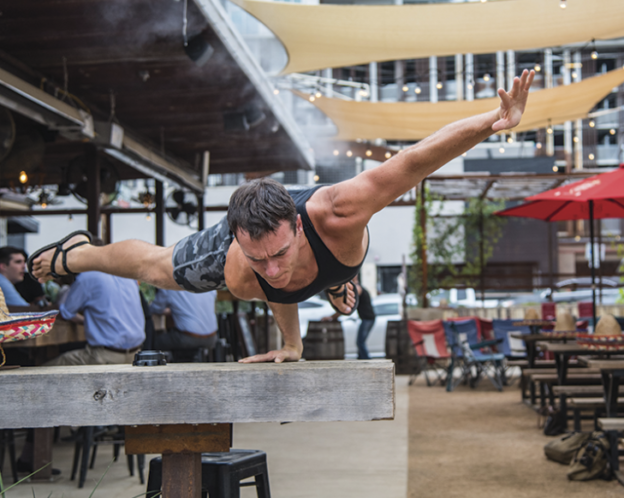
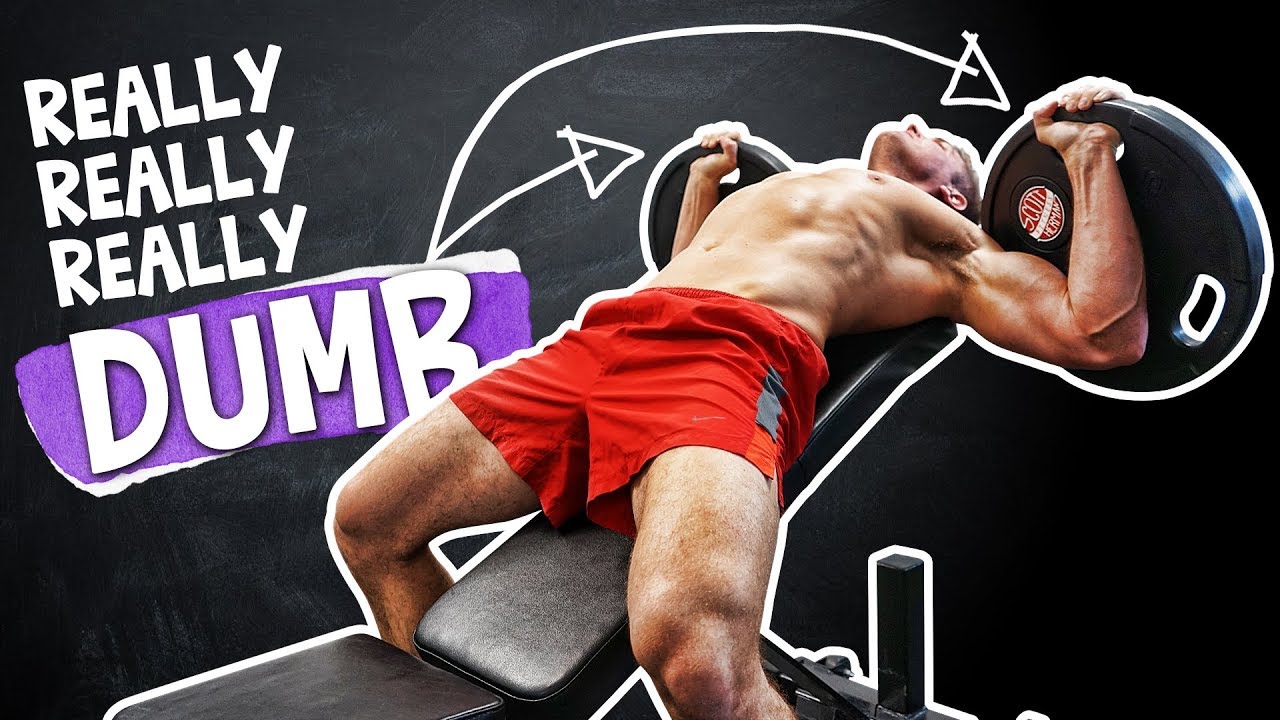
Every day you see these trainers – with thousands or even millions of followers – perform flying push-ups on stacked-up dumbbells, climbing two ropes with a med ball between their feet, or doing a standing ab wheel rollout on a barbell. The majority of their content is just “Hey, look at me and look what I can do!” It’s narcissistic and egotistical.
Here’s my issue. What are these party-trick videos teaching people about exercise? Absolutely nothing. How is watching some IG clown doing a backflip burpee with battle ropes helping the average guy who struggles to perform five push-ups? It’s not.
It’s teaching the average person nothing about proper exercise, mastering the fundamentals, or training in general. Not only that, but often it only makes them feel worse about themselves and their current physical condition.
Most fitness on social media is nonsense. These people don’t care about you. These “influencers” are much more concerned about getting more likes and followers than helping you achieve your goals.
Want to lose weight? Eat less. Walk more. Want to get lean and build muscle? Lift weights and eat more protein. See what I’m saying? No one wants to hear the unsexy truth.
Effective training can be boring. Getting good results requires a ton of fairly mundane and repetitive workouts done day after day, year after year. You rinse and repeat the same 20-30 movement patterns over a lifetime. A lean, muscular, and strong physique is the product of consistent hard work prioritizing basic movements for years.
Any trainer that truly wants to help you isn’t going to entertain you; they’re going to educate you. A good trainer won’t tell you what you want to hear but rather what you need to hear. They may not always give you the advice you want, but they will give you the advice you need.
Consume social media intentionally. Know the difference between a good trainer and an “influencer.” Don’t be entertained. Be educated.
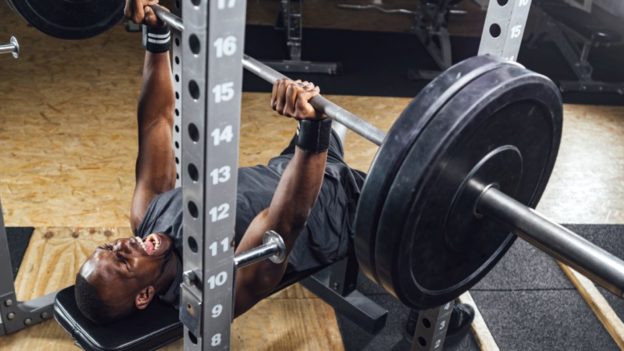
Everyday I go to the gym, I walk past the bench press area and I see people either lifting too much weight , using horrible form, or using horrible form while lifting too much weight. I personally do not want to ever see someone get injured to the point where they are in pain and/or can stall their progress in whatever fitness journey they are on. So I am sharing a quick list of do’s and dont’s for anyone wanting to develop a solid bench press.
Do keep a slight arch in your lower back, with your feet planted firmly on the floor and your chest high.
Do take a slightly wider-than-shoulder-width grip on the bar.
Do have a spotter standing by.
Do touch the bar to just below the lower-pec line.
Do push the bar up and slightly back towards the rack follow your natural strength curve.
Do inhale as you lower the bar and exhale as you drive the bar back to the start position.
Do use a two-seconds-up/two-seconds-down cadence.
Do keep the bar moving! No rest at the top or bottom unless you’re powerlifting.
Do use exercises like the ones shown below to properly warm up strengthen those small muscles in the shoulders (rotator cuffs) and back so you can move more freely and lift heavier with decreased chance of injury.
Don’t let your feet move during the lift. Maintain a permanent foot position to create a solid base of strength.
Pro Tip: Focus on pushing your feet through the floor to create a tight base from you feet through your torso
Don’t take a narrow grip unless you’re training triceps instead of chest.
Don’t take a grip that’s much wider than shoulder width or you could damage your rotator cuff muscles.
Don’t drop the bar through space to bounce it off your chest. Maintain control at all times.
Don’t rest at the top’keep the bar moving.
There they are ..this is a quick post but the info provided can be very helpful for getting that 315 pound bench press you are trying to achieve! (Why does everyone set 315 to be a milestone for bench press? ¯\_(ツ)_/¯ ) If you want to see anymore tips or tricks for building a strong bench press, drop a comment and let me know.
I normally end with Eat Smart Train Hard. Today will simply be ending with Train Smart!!
NOW that Valentines Day is over. Its time to get down to business. There are no other holidays between now and when it will be warm. It’s time to put in 100% focus on getting in the best shape of your life!! That summer body!
I mean the goal is to Look Great and Feel Great… right?!
If so, this 12 week program is perfect for any woman who is looking to transform her body through a good weight lifting program.
The goal is to help you develop lean and functional muscle tone through foundational lifts. The workout itself targets your lower body three times a week with a strong focus on your glutes, and your upper body twice a week with a focus on sculpting the muscles of the arms.
Jaqueline Lomax
To increase the total number of calories burned each day, there are some recommended cardio sessions that you can do either in the morning or after that day’s workout. However, if you are limited on time, they are not required to see progress with this workout.
Rest periods for this program should be kept to 30-90 seconds in between sets and exercises.
Workout Schedule
Monday – Legs & Glutes, Cardio (optional)
Tuesday – Back & Arms, Cardio (optional)
Wednesday – Legs & Glutes, Cardio (optional)
Thursday – Chest & Shoulders, Cardio (optional)
Friday – Legs & Arms, Cardio (optional)
Saturday – Abs/Active Rest
Sunday – Abs/Active Rest
Monday – Legs & Glutes
Exercise
Sets
Reps
1. Squat
3-4
6-12
2. Dumbbell Lunge
2-3
12-15
3. Dumbbell Step Up
2-3
12-15
4. Barbell Hip Thrust
3
6-12
5. Glute Cable Kickback
2-3
12-15
Cardio – 15 min of HIIT on Stationary Bike
Tuesday – Back & Arms
Exercise
Sets
Reps
1. Pull Downs
3-4
6-12
2. One Arm Dumbbell Row
2-3
12-15
3. Seated Cable Row
2-3
12-15
4a. Dumbbell Curl
3
12
4b. Tricep Overhead Extension
3
12
5a. Cable Curl
3
15
5b. Cable Pressdown
3
15
Cardio – 30 mins of moderate intensity on Stairmill
Wednesday – Legs & Glutes
Exercise
Sets
Reps
1. Goblet Squat
3-4
6-12
2. Romanian Deadlift
2-3
12-15
3. Dumbbell Stiff Leg Deadlift
2-3
12-15
4. Smith Machine Sumo Squats (Glute Focus)
3
6-12
5. Glute Kick Back
3
15
Cardio – 30 min low intensity on treadmill at a 10-15% incline
Thursday – Chest & Shoulders
Exercise
Sets
Reps
1. Dumbbell Bench Press
3-4
6-12
2. Incline Dumbbell Press
2-3
12-15
3. Machine Chest Fly
2-3
12-15
4. Seated Dumbbell Press
3-4
6-12
5. Lateral Raise
2-3
12-15
Cardio – 15 min of HIIT on rower or stationary bike
Friday – Legs & Arms
Exercise
Sets
Reps
1. Deadlifts
3-4
6-12
2. Good Mornings
2-3
12-15
3. Leg Extensions
2-3
12-15
4. Incline Dumbbell Curl
3
12
5. Incline Skullcrusher
3
12
Cardio – 30 min of moderate intensity on a Stairmill
Weekends:
Light activity – recovery walks and optional ab workout
It is important to note that your success with any workout program depends greatly on your nutrition and sleep/recovery habits. Make sure you get 7-9 hours of sleep each night and eat enough calories to help you get the results you desire.
A BMR calculator will help you know how many calories you need to maintain your current body weight.
If your goal is to lose weight, subtract ~250 calories from this number. If you are underweight, try to add ~250 calories to this number. And if you are already at your ideal weight, make sure to eat the proper amount of calories to maintain.
Tracking Progress
It is important to track your results to show you’ve made progress with this program. At the beginning of the 12 weeks you should plan to take your preferred form of measurements.
Massy Arias
These measurements can include progress pictures, scale weighing, tape measurements, and skinfold caliper measurements. I recommend starting with what you are most comfortable with first and adding more as you feel comfortable.
The more data you have on yourself, the better you can tinker with variables such as increasing reps, sets, or weight used during your workouts, increasing the hours you sleep each night, increasing the amount of cardio you do each week, and/or increasing or decreasing the amount of calories you eat each day.
How frequently you measure your progress is completely up to you, but I’d recommend doing so once a month or 6 weeks to make sure you are progressing towards your goals.
Progressing with This Workout
You should strive to increase some variable within your workout each week. Whether that means increasing the weight you use or the amount of rep and sets you perform is going to be based on your individual preference.
One way you could go about it is to start off with the low end on all of the set and rep counts. Then each week add a single set on one exercise each day of each week. Once you’re doing all the maximum amount of recommended sets for each exercise, you could then add in 1-2 reps to each set of each exercise for the remaining weeks.
Another way you could progress is to keep your reps and sets the same throughout the whole 12 weeks. But each week you should aim to slightly increase the weight you use for each exercise.
Either way works and will help you see great results.
What Should I Do After the 12 weeks?
After you’ve completed the 12 weeks of this program, you should take a week to deload.
Celebrate the journey you have just taken and decide if you wish to continue to make improvements.
If after you deload, you decide you’d like to try another 12 weeks of this program, then you should come back refreshed and ready to make more progress.
If you have any questions or would like to leave a review for this program, please feel free to leave a comment in the comments section below!
Also, feel free to join the community. Post your progress photos, workouts, etc. and engage with fellow gym junkiez!
First time I met Tim was during a local competition 15 years ago. I was competing as a light heavy weight. Had just come off of winning multiple OCB competitions and was getting my first taste of competition in the NPC.
It was the evening time and finals were just about to begin. I knew I had the light heavy weight class in the bag and was focused on getting that overall win!
Fast forward to the finals…
We are lining up to walk on stage and battle it out. In front of me stands Tim in a windbreaker. I had not seen him before that moment but also didn’t care because I just KNEW i was going to win!
Tim looks back, says good luck and takes off the jacket.
DAMN!
Suffice to say I did not win the overall, LOL!
That was the very moment I learned to be humble and the moment that I also learned I had A LOT of work to do in order to get my back to his level of development and conditioning!
That was the day I became obsessed with the gym and bodybuilding in general!
Meet IFBB Pro, Tim Fernandez!
How did you get your start in Bodybuilding?
I’ve always been very competitive. I wrestled in middle school and in high school. One day I was with my mom at the grocery store and saw a flex magazine with Lee Priest on the cover. I read an article about him and I knew right then and there I wanted to be a body builder. I told my mom about it and my 15th birthday was pretty close at that time. She actually bought me a weider weight set with all the cool attachments. Needless to say I was hooked and bodybuilding was all I thought about. I wore that weight set out! Here we are twenty five years later and still blessed to still be doing what I love!
Where does your motivation come from?
This is a great question. Over the years my motivation has changed. When I was young I was picked on because I never really fit in. I never wanted to hang out and do pointless shit. Needless to say I was motivated by anger and felt I had something to prove. I was able to flip a switch on in the gym and take all that anger and put it into something positive. I could go to a very dark place and it seriously made me so much stronger. It was definitely an edge I had on most. These days are different though. Don’t get me wrong, I can still tap into that dark place but I choose not to. Now I am motivated by my beautiful family. I want my kids to know that with hard work and dedication they can achieve anything. I truly believe in leading by example. At the end of the day I just want to make my family proud.
What workout routine has worked best for you? (Maybe a sample routine you have used)
My favorite routine has always been each body part once a week. I believe if you train hard enough that’s really all you need and you allow ample time for recovery. Leg day I always allowed two days of recovery after training. Then I would simply train each body part and allow a day of rest in between each one. I was never one to over think or over complicate things. I like keeping it simple. Work your ass off, eat, rest, grow and repeat.
If you had to pick only 3 exercises, what would they be and why?
The top three for me would without a doubt would be squats, deadlifts, and dumbbell bench press. I chose these because these are the big muscle builders they really lay a strong foundation for getting strong and building muscle.
What’s a normal day of eating for you like?
These days I honestly am an intuitive eater. I pay attention to the mirror, not the scale. Bodybuilding judges don’t ask you your weight when you’re up there. When I go into prep mode I do get very serious as far as weighing out food and getting meals in every few hours. The goal is to keep as much lean mass while dieting. Again, I keep it simple though and eat pretty clean all year round. I’m in it for the long haul now, as I get older and now that I’m a father and a husband I need to stay healthy.
So, as far as the foods I eat in a typical day. For breakfast I eat eggs and oatmeal along with my water and coffee. Next two meals are chicken, rice, and avocados. Then I do a shake and some natty PB. Post workout consists of another shake. Before bed I like to eat my egg whites and oats. If I wake up in the middle of the night I slam down another shake. Again, I like to keep things simple!!
What’s the best advice you can give someone looking to get started in the bodybuilding/fitness lifestyle?
99 percent of getting good at something is being consistent. It’s not going to happen over night and remember this is not a sprint, it’s a marathon. Train smart and leave your ego at the door. Every and any injury is a set back in the wrong direction. Train hard, get your nutrition in and rest up. The most important thing is to have fun doing it. It truly is rewarding and the discipline you learn from bodybuilding will take you far in life.
Favorite Quote?
“Live as if you were to die tomorrow. Learn as if you were to live forever.”– Mahatma Gandhi
Tim is one of the most authentic, hardworking, consistent guys you will ever come across. His passion for the sport and knowledge of nutrition and training is top notch! Although newly inducted as an IFBB Pro Bodybuilder, Tim is first and foremost a family man, and business owner. Tim and his wife own the businesses linked below! Check them out!!! Support our fellow Gym Junkiez! Tim appreciate you taking the time and letting everyone get to know a little about you bro!! Thank you! As for everyone else. Eat Smart! Train Hard!!!
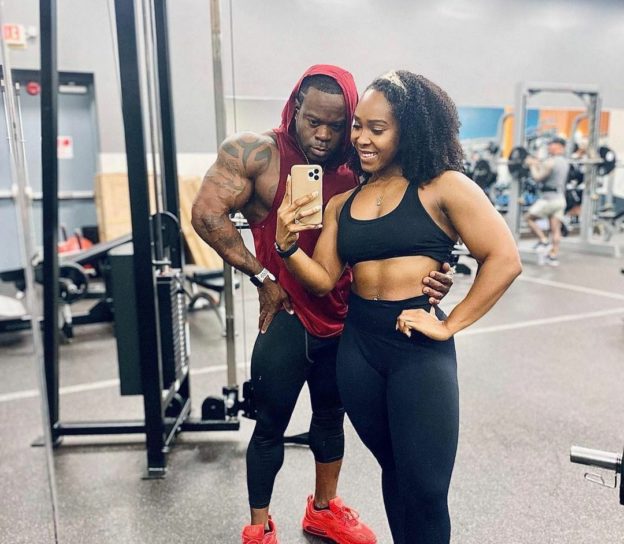
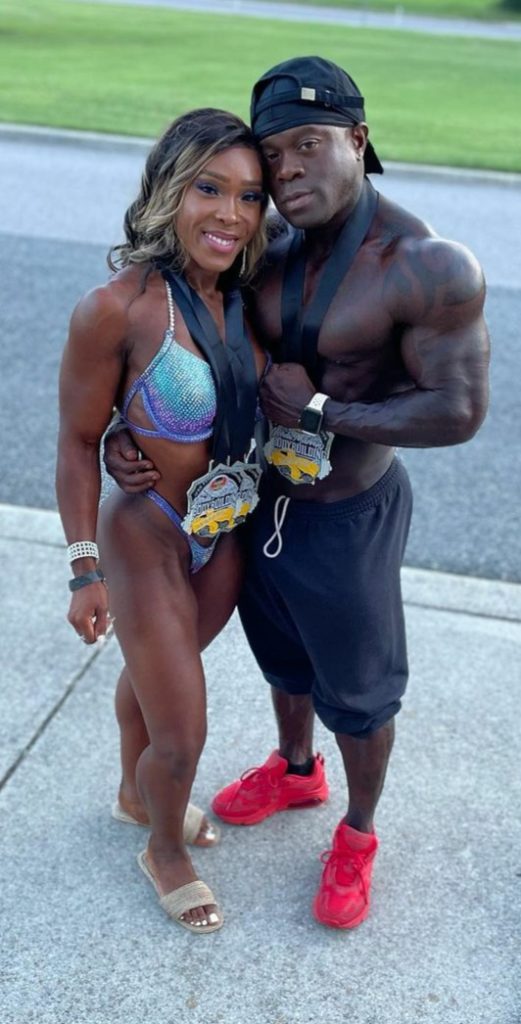
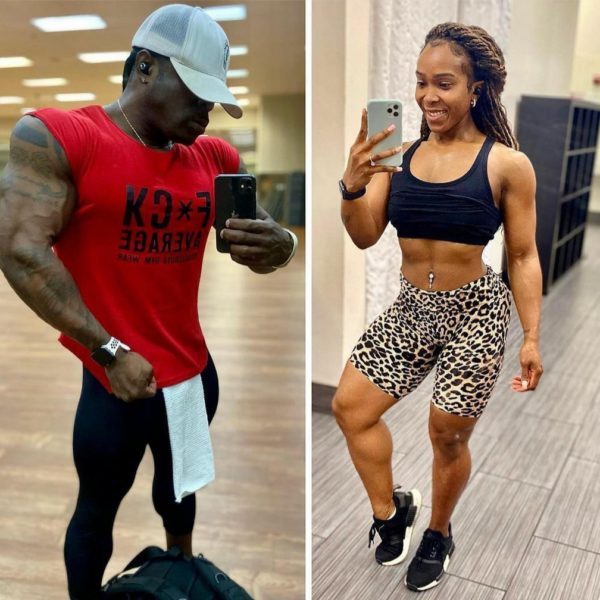
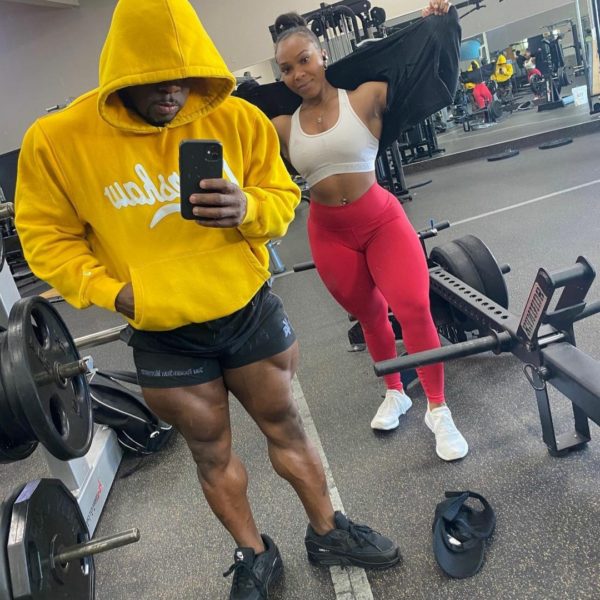
The fitness world’s version of Martin and Gina!! (inside joke!)
This is a small world! I have had the pleasure to know both of them individually, as well as witness them come together and build an awesome relationship and partnership. Their personalities compliment each other and the way they support one another is something to aspire to.
Both of them have done extremely well as physique competitors, as they have either won the overall or placed in the top of their perspective classes in all past competitions.
Mike has developed a wealth of knowledge in training, nutrition, contest prep, etc.. He is a training and nutrition coach. Mike also co-hosts a podcast called the “Free Game Social Club”.
Na’Dean has been a fitness enthusiasts for a few years. I can honestly say I have NEVER seen her not smiling, even when in the midst of training! You can absolutely tell, Na’Dean loves the fitness lifestyle.
Although she is still relatively new to the competing, Na’Dean is quickly making a name for herself in the Wellness division!
What’s up guys!! Can you tell the community a little about yourselves?
Mike: hi, I’m Mike.. I’m 35 years old, from Houston, Texas; now in Va. I love working out, Movies, drug documentaries, hanging around my best friend and fiancé Na’Dean, bodybuilding and helping others in any way.. whether that be advice for life, nutrition, business, exercising, etc.
Na’Dean: I am Na’Dean, Mike’s Fiancée. I am a child of the most high God. I am a fitness enthusiast who just so happens to compete as a hobby, and I love connecting with people.
Mike, I hear you are an all-star in the insurance game too?!
After experiencing my tragic loss of my son and late wife to a car accident it made me want to help others be properly prepared in that time of need when the Lord calls. But yea I’m getting my feet wet as I’ve been a licensed insurance agent for roughly 11 months now. I love it a lot and gives me the opportunity to help families make sure they have the proper protection in place. Shoutout to Family First Life!!!
How long have you guys been in the fitness/ competitive physique world?
Mike: I have been in the fitness and competitive world consistently for the last 6 years.
Na’Dean: I’ve been in the fitness world, I want to say since about 2009. That’s when I started hitting the gym, learning the ins and outs and being consistent with it. I’ve been competing since 2019.
What’s it like training with each other?
Mike: It’s awesome!! Having someone that understands your love and passion for the sport as well as lifting and also displays that same passion. It is so amazing!! It helps us to push each other while also bringing us closer as a couple.
Na’Dean: I absolutely love training with Mike. It’s amazing because he pushes me and teaches me different training methods that I’ve either never done before, or haven’t done in a while. Honestly, it is one of my favorite things to do. He’s always in his element when he is training, so I love being able to be a part of what makes him happy!!
Can you give a quick breakdown of your training regimen?
Mike: For me training is therapy so I take it super serious! Not much of a talker when training but I will give my occasional head nod/ fist bump to remain cordial. I’m constantly moving to keep my HR and intensity where it needs to be. But I’ve always stuck to the good ol’ PUSH PULL LEGS training split. That’s always worked best for me. Training 6 days a week allows to hit each muscle group twice a week. When I am taxed, i train legs once. Rest day is always Sunday aka refeed and relax day lol.
Na’Dean: With me being a wellness competitor, the focus is on growing and building the legs and glutes with less emphasis on upper body.
Favorite trait/ bodypart about him/her?
Mike: Man!! My favorite trait about Na’Dean…..man there are so many to be honest but she is dedicated, hard working, kind, selfless and has just an all around great spirit about her that is very contagious and beautiful( Lawd Jesus). BUT my favorite body part….DAT ASS aka da cakes and that lil waist lol
Na’Dean: This is tough because I just love his entire physique!! I’m torn between his arms and his legs. As far as traits, I love that he’s such a selfless individual. I’ve never met anyone with a heart as open and kind as his.
Both of you have an impressive set of wheels… whose leg training days are worse?
Na’Dean: Thank you! Gotta go with Mike’s leg training day’s. They’re brutal.
Mike: Yea, I will have to say my leg day is the worse. but Na’Dean actually does a great job keeping up and not complaining one bit. She does better than most men that have trained legs with me and that’s being 100!
Since both of you are competitors, describe what your experience has been with each other during competition prep? Good bad or indifferent…
Mike: Prep with Na’Dean was really great to be honest! I think we completely had a great understanding of what we both signed up for so there were never any moments of anger, being hangry at one another, or taking out our frustrations on each other when food got low etc. It was a cool experience because we really worked together as a team to help solve issues such as, helping each other prep and cook specific foods, weighing it out, etc. Thankfully and in all honesty I can say that the experience helped make us better as a couple and reminded me that if we work as a team we can achieve anything, and even when calories were low and cardio was doubled we still made time to kill it in the bedroom too so win win for me lol..
Na’Dean: In my opinion, it has been amazing! I honestly cannot picture us not prepping together. It just works. We are able to go through the experience together. The highs, the lows, the low moods (we don’t do mood swings in our crib).
Who is the better cook? “Normal” food and comp prep (yea there is a difference!)
Mike: Both of us! LOL
Na’Dean: Mmmm…. Good one. Well since you asked who is “better” at it, Mike is the better cook for sure when it comes to prep food. He’s also very good at regular food but I like to think I’m better at it lol.
Any plans for competing in 2022? If so what show(s)
Mike: Yes, our wedding! THE biggest competition of them all lol
Na’Dean: Sadly, no shows for 2022. We are only prepping for our wedding in August of 2022. Maybe you’ll catch us in a stage in 2023… who knows.
What about the other motivates you?
Mike: Just her as an individual, I always prayed that God blessed me with a woman that doesn’t need me but wants me if that makes sense. but together we are better! So her independence, her dedication and willingness not to give up when times get hard and seeing her have the drive to want to be a better version of herself in and out the gym is what makes me want to step it up on another level!
Na’Dean: His selflessness motivates me to be more selfless. He is also very determined and goal oriented which pushes me to be the same.
Best piece of advice you can give to couples that either want to begin the fitness lifestyle together.. or already living it and how to navigate it together…
Mike: Best advice is to support, Support, SUPPORT your significant other/spouse!!!
Work together as a team and consistently communicate about goals so you both can understand each others why. Everyone has their strengths and weaknesses, so you have to work to compliment one another and push each other to be better! To my men that complain about their lady not being into the gym…. help them, invite them to workout with you. if they don’t come with you… then start small, ask them to go on walks with you then work your way up. Change the scenery in the kitchen also! Start providing healthier options to cook, or better yet, YOU cook healthier meals for the both of you!
As men, we have to lead by example! If she sees you making positive changes, she will likely join and if not.. remain focused on her while you continue to make those healthier choices. Trust me it will improve the relationship, etc.
Na’Dean: Write your goals down collectively, and make sure that every day each of you are doing what it takes to accomplish it. A goal without a plan and a call to action is just a thought. Stick by each other and understand that the other is your equal. You are in it together. Hold each other accountable and always encourage one another to be, and do better than yesterday.
Thank you to Mike and Na’Dean for taking the time to share about their love for the sport, the fitness culture, and each other. You can follow them on their journey in the Gym Junkiez community, or you can follow their IG Pages… Mike0225 and MsNadean
For the Gym Junkiez that love to train legs, or are training legs with the purpose of growing an impressive set of wheels…. this challenge is for you!!!
The ladies can do this just as well as the guys! And to be perfectly honest, the ladies may like it more!!!!!
This workout consists of 1 Giant Set; 2 rounds x 7 Exercises; 12-25 rep MAX Effort!! (explanation to follow)
Before we get to the workout, lets cover the basics of Blood Flow Restriction….
What is Blood Flow Restriction?
Blood flow restriction (BFR) is a training method partially restricting arterial inflow and fully restricting venous outflow in working musculature by wrapping a pressure apparatus around the limb during exercise (Scott et al., 2015). This arrangement allows for a swelling effect of the muscle, which is the first mechanism of muscle growth. Blood flow restriction also causes a buildup of metabolites, such as lactic acid, that have been shown to directly stimulate muscle growth. And the direct fatigue caused to the muscle forces the nervous system to recruit the largest fast-twitch muscle fibers, which have the greatest capacity for growth.
This style of training can be used on recovery days, or as a finisher to the workout. These short intense sessions tax your body a great deal, but at the same time you are removing a great deal of stress and strain off of your joints and ligaments.
This is one of those rare occasions where you get MORE for Less!
How does BFR work?
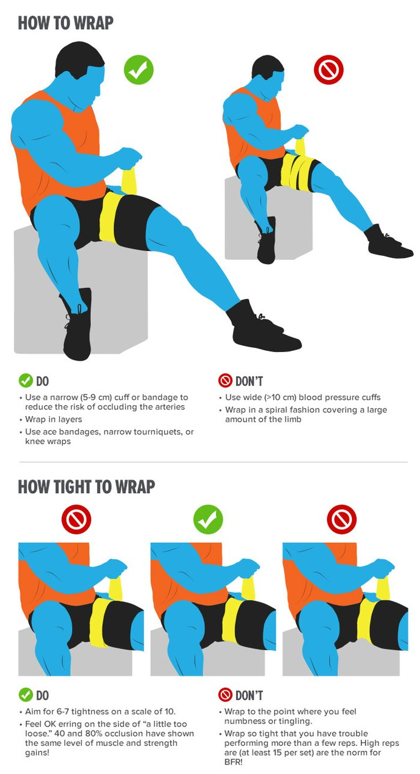
Wrap the limb (see diagram below) with some type of pressure cuff (BFR Bands, pressure cuff, or even knee wraps). On a scale of 1-10 for tightness of the wrap, you should aim for 6-7 out of 10. Use a weight that would equal anywhere from 40%-50% of your 1 rep max. Aim to complete anywhere from 15-30 reps per set.
Now, lets get to the finishing set!
LEG DAY FINISHER
One Giant Set Consisting of Full Range of Motion; SQUEEZE every rep!!!
Once you wrap up; complete the following:
**Glute Ham Raises on Lat Pulldown Machine
Leg Extensions – 25 reps
Lying Hamstring Curls – 25 reps
Leg Press – 20 reps
Dumbbell Romanian Deadlift – 15 reps
Dumbbell Goblet Squat – 20 reps
Glute/Ham Raises on Lat Pull Down Machine** – 12 reps
Walking Barbell/Dumbbell Lunges – 15 reps each leg
*ADVANCED – 2 Rounds – After each round take 2 – 3 Full Minutes of Rest. You will absolutely need every second of it.
For those that did the 2 rounds … If you did this correctly you will need to find a nice corner in the gym to lay down in. And just to be on the safe side…. take a trash can with you!
I will tell you, I completed 2 sets of this on my last leg day! In 12 minutes I had a MASSIVE pump compared to the first 45 minutes of my workout! I laid under the steps with a towel on my face 😂😂😂. DONT JUDGE ME!
Seriously, give this a try. You will definitely get a great workout and some great leg development.
If you record it! Post the videos and/or pictures in the activity feed! Or tag us on IG @Gym_junkiez17
Train Hard!!!
References
Scott, B. R., Loenneke, J. P., Slattery, K. M., and Dascombe, B. J. (2015). Exercise with blood flow restriction: an updated evidence-based approach for enhanced muscular development. Sports Med. 45, 313–325. doi: 10.1007/s40279-014-0288-1
You are grinding it out in the gym, day in and day out.
You are getting stronger.
You are getting more muscular and everything with the world is right!
After a while, you notice that you stopped making strength gains, and your arms and shoulders look smaller. So you start training harder thinking that you need to do more to make up for what seems lost.
Muscle soreness and joint pain set in. You try to work through or work around the pain and it slowly gets worse.
Now your motivation to go to the gym starts to dwindle, but you go anyway because mentally you know that missing the gym is going to cause setbacks.
What’s really happening is your body is telling you that you need a break! Rest is just as important to strength and muscle growth as training. But again mentally you do not want to stop going to the gym because you are afraid of “falling off” so to speak.
At this moment, you should consider adding a deload to your regimen. It will work wonders for both your physical and mental health.
What’s a deload week?
A deload week, as the name implies, is a scheduled week for reduction in the total intensity and/or volume of your workouts. In laymen’s terms, you workout with enough resistance to get a light pump and still have reps in the tank!
Why do you need a deload week?
To avoid overtraining and/or to recover from a period of strength/performance plateaus, as well as decreased energy levels. A properly planned/executed deload week allows your connective tissue time to repair (since muscle recovers more quickly than your joints and ligaments), restores testosterone, and decreases cortisol levels. Moreover, a deload week gives your mind the chance to relax and get away from the intensity that consistently hard/heavy workouts can provide. After a deload week you should be stronger mentally and physically, and ready to start the next phase of your strength/performance training!
When do you need a deload week?
Most strength training programs schedule a deload week at the 4-week mark. If you are not following any form of a strength training program, there are some telltale signs that give you an indication of when to throw in a deload week. These include…
feeling weak; unable to consistently lift heavy weight (which is a sign that your CNS has tapped out)
overly sore muscles from everyday functional use
sore joints; ligaments
lack of motivation; desire to work out
How do you complete a deload week? There are a couple of options that will help you successfully navigate a deload phase. Choose which works best for you
Do your normal routine and normal volume (sets & reps) but reduce the weight you use to about 50-60% of what you normally work out with for each exercise.
Use the same weight as you normally would but drop your total number of sets x reps to 50-60% of your normal volume. (Note that you should stick to an 8+ rep scheme here.)
Use lighter weight and focus on refining your form and technique
Focus on mobility by doing dynamic and static stretching (when applicable)
A “week” was referenced several times in correlation to deloading as its the most common timeframe to use. Typically, a week is all you need, but please know you can complete a deload phase in as little as 3 days or as many as 10 days. It is totally up to you but believe me your body will tell you exactly how long you need. And truth be told after 3-4 days most get the itch to start moving weight again!
It is important to note that a deload phase will cause little to no delay in long-term strength training progress. It’s equally important to note that the chances of losing muscle size during a deload phase is slim to none. Therefore, if you feel like you would psychologically benefit from a deload week, then there is absolutely no reason to avoid taking one, and it may well help you return to training with renewed enthusiasm. Ideally, the decision about whether to take a deload would be made at the point when you are ready for one, rather than in advance.
Now, if you are experiencing large reductions in strength (or even size) during your strength training program, or if feel like your muscles, or even your joints and ligaments, might be suffering fatigue damage such that they cannot recover in time for the next workout, then the real solution to your problem is most likely not a deload phase, but a more permanent change to your strength training frequency or volume. A change that will allow you to recover properly from one workout to the next.
Hope this helps. Till the next time Train Smart!!!!!
One of the most overlooked, yet most important factors for improving health, performance, and in getting the physique you want is Sleep.
NOT rest; SLEEP.
Your workout performance gets compromised due to poor sleep habits. Various studies have linked high quality sleep to faster reaction times, faster sprints, better skill acquisition, greater endurance, and stronger lifts.
Below are 8 Tips for Improving your Sleep Hygiene…
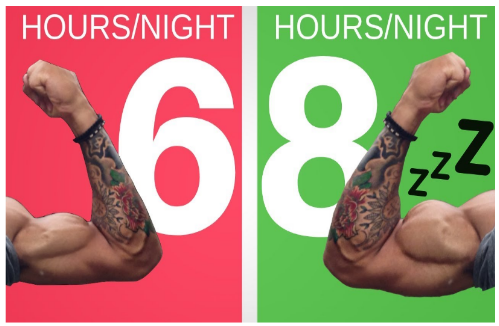
8 hours sleep is recommended to optimize recovery and performance
Avoid caffeine at least 6-7 hours before bed. “As we get older, our ability to metabolize caffeine and get it out of our system slows down,” says Dr. Ronit Levy, a psychologist and clinical director at Bucks County Anxiety Center. “If it’s still in your system at bedtime, you’ll be exhausted but have a hard time falling asleep.”
Consider supplementing with Zinc (9.5 mg for men; 7mg for women), Magnesium (300mg for men; 270mg for women), and/or Melatonin (5mg) up to one hour before bed. These have proven to be very effective for increasing the quality of sleep.
Dim the lights in your house or apartment an hour before bed. Bright lights may interfere with the secretion of hormones that help you sleep.
Only use your bed for sleep or sex. Don’t spend time scrolling on your phone. With a large percentage of the population working form home its important to note that you absolutely should not work in bed. Maintaining these habits helps your mind to associate getting into bed with sleep and relaxation.
Consider spending five or ten minutes stretching before bed.
Consider reading before bed. According to Dr. David Rabin, a psychiatrist, neuroscientist, and co-founder of Apollo Neuroscience. “Read something enjoyable like fiction or something interesting and educational before bed. It can be great for helping the mind to wind down.”
Dr. Rabin also believes that focusing on your breath can help sleep to come when you’re lying in bed. “Engaging in the breath pattern of a person who is asleep — roughly two to four breaths per minute, so one breath in and out every fifteen seconds — will put you to sleep in five to ten minutes almost every time,” he says. “It’s a technique to help control anxiety and get you into a more deescalated state, and it can radically improve your sleep.”
Go to sleep the same time every night and stick to the same routine as your day comes to a close. This helps to ingrain sleep as a habit.
One last thing. I strongly encourage you to work towards getting a minimum of 8 hours of sleep every night! It will be a small sacrifice to your night life but in the long run you will be thankful you made that decision.
I will end this like it started. Improve your sleep, improve your physique, improve your health!
“If you wake up at 4am to do cardio after only getting 5 hours of sleep, you are stepping over $100 bills to pick up nickels…” Stan Effering